


The holiday season’s one of the busiest times of the year in the Big Bend region of West Texas, beloved for its cool desert temperatures and wide-open state and national parks.
There’s currently a new spread of public land being developed in the remote Chinati Mountains south of Marfa. And while it’s not set to formally open until 2032, park officials are now working on ways to let people in sooner.
The main entrance to the park will be about 30 minutes outside the border town of Presidio, off of FM 170, which hugs the Rio Grande. The development of the new park is projected to cost anywhere from $30 to $60 million dollars, and could bring upward of 60,000 new visitors to the area per year, according to park officials.
Marfa Public Radio recently got a sneak peek of the new state natural area, 39,000 acres of pristine Chihuahuan Desert landscape that also boasts a rich human history.

On a recent cloudy day in south Presidio County, Cody Edwards starts up a UTV near the new state natural area’s entrance. Edwards, superintendent of the nearby Big Bend Ranch State Park, is also currently overseeing the development of the new park.
“I try not to go anywhere into the back country without a jack, a tire plug kit, a small compressor to air up tires and my trusty traction boards,” he said.
The landscape is filled with fleeing jackrabbits, towering yuccas and rugged mountains, remnants of a super volcano that erupted here millions of years ago.

Texas is in the midst of a public land boom, made possible by a billion-dollar state endowment created a couple years ago. But this swath of Chinati Mountain rangeland has been in state hands since the 1990s. Lack of a public access road has delayed its debut, until now.
Like other state natural areas, Chinati will remain pretty primitive, Edwards said.
“We’re really trying to minimize extensive development in order to provide, you know, that wilderness, that raw outdoor experience,” he said.
In 2026, select local outfitters will be allowed to bring small groups into the park, meaning some lucky hikers will have the chance to access the Chinatis before the 2032 opening date. Park boosters also recently announced plans for a raffle to allow a handful of people onto the land on New Year’s Day, as the Big Bend Sentinel has reported.
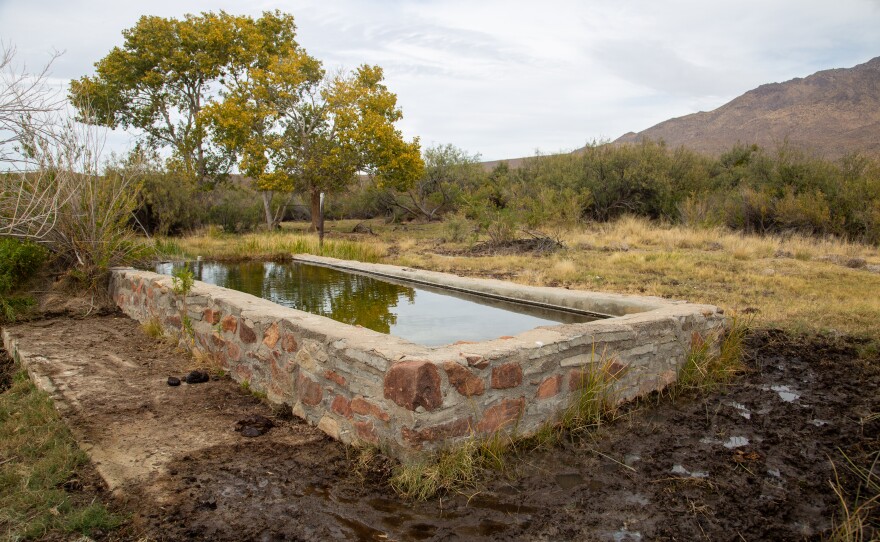


Features that set this new state natural area apart from other nearby parks are an abundance of springs, in particular, a rare salt marsh cienaga, or spring-fed wetland. There are also stone cabins that will be refurbished for public use. While the park doesn’t encompass Chinati Peak, it will still be billed as a premiere hiking destination with 50 to 100 miles of trails.

Jose Alonzo Muñiz grew up on this land. His family ran cattle near the Chinati Mountains for nearly 40 years. Muñiz now manages a herd of longhorn at nearby Big Bend Ranch State Park. He said he’s glad his old stomping grounds are becoming a public park.
“It's very green, in summertime, and all you gotta do is just watch out for rattlesnakes,” Muñiz said.

Muñiz recalled riding the fence on horseback and getting caught in storms during the summer monsoons, when heavy afternoon rains often led to flooded arroyos and dangerous conditions.
"I would get my dad under some brush and cover him up with some saddle blankets and saddles and hail would hit us, lightning and just get out of there as safe as we could,” he said.
According to park officials, there is evidence of human occupation in the Chinatis dating back several thousand years, so one of their major goals will be to locate valuable archaeological sites and ensure their preservation before tourists start streaming in.
Local archeologist and historian David Keller will be a part of that effort. He said he’s expecting to find plenty of evidence of prehistoric people — where they camped, prepared meals and made tools. But a lot of that history just hasn’t been studied here before.
“You could almost say, safely, the Chinatis are largely unknown to science,” he said.
“I have a botanist friend who's got a permit, he's aching to get in there because there's so little known,” Keller said. “It’s terra incognita so it is very exciting.”
Local resident Arian Velázquez-Ornelas works for the Texas Parks and Wildlife Department as a park interpreter, and she hopes archeological digs will result in new information about the area’s indigenous populations.

Her own husband, a Presidio local with Lipan Apache heritage, is a lineal descendant of human remains uncovered by Chinati Peak dating back to the year 1275.
“This is still continuously the same people, you know, generations upon generations afterwards,” Velázquez-Ornelas said. “And so to me, that's a very important part of my job, is being able to provide that history that connects us to the resources, to this pristine land.”
Back at the park, Edwards drives the UTV up to a lookout with spectacular views — three canyons, all converging with Chinati Peak in the distance.

Edwards proposed to his wife on a mountain peak in nearby Big Bend National Park and named his daughter Elena, after Santa Elena Canyon. He said this planning phase of the new state natural area is a defining moment.
“I want to do right by this place and that's what my staff wants too,” he said. “That’s why we're here and that's the driving force for me.”
At the forefront of his mind, Edwards said, is the delicate balance ahead — between increasing accessibility and protecting this precious piece of borderland back country.
This reporting was made possible by generous donations from supporters like you. Please consider making a donation to Marfa Public Radio to fund the journalism you rely on.
