



On a recent morning in the small town of Alpine, staffers at the Family Crisis Center of the Big Bend gathered for a meeting, affixing orange ribbons to their shirts in recognition of teen dating violence awareness month in February.
The nearly 40-year-old nonprofit organization, dedicated to helping survivors of crimes like domestic violence and sexual assault, recently raised more than $1 million to purchase and renovate a new headquarters building that includes an emergency shelter.
The center is one of the only organizations of its kind across a five-county region of rural West Texas, a place where advocates say these types of crimes are seriously underreported, as they are nationwide.
While combating these pervasive crimes on the local level is no easy feat, crisis center employees say they remain committed to facing the issues head on, even in spite of the inherent challenges of doing this work in one of the nation’s most remote rural areas.


Leticia Carrillo is the group’s executive director. A former local law enforcement officer, she said even she didn’t realize how extensive the center’s services are.
“We provide not just emergency shelter,” she said. “We provide counseling, we provide financial assistance, we help them in finding employment, we help them with childcare.”
Someone who’s directly benefited from those services is Delisa Kearns, a single mom in Alpine. She separated from her husband and then experienced a debilitating stroke in 2018 that prompted her to reach out to the crisis center.
Kearns said it’s hard to put trauma and abuse into words and seek out help. But when she did, the crisis center jumped in to provide basic household supplies, financial assistance with bills and emotional support for her and her two girls.
“Nobody chooses to be abused, nobody chooses to get married to get a divorce, it just happens,” Kearns said. “You just hope you live day by day.”
The crisis center runs other critical social services like transportation — shuttling residents to doctors appointments and airports in cities hours away — and food distribution.
“ We have to pick up and do things that maybe aren't really in our scope,” Carrillo said. “But we do it because if we don't do it, who else will do it?”
The organization’s satellite offices in Presidio and Terlingua reflect the character of the communities they serve: the Terlingua location, in the heart of the ghost town, has stone floors, a bamboo ceiling and even a resident roadrunner.
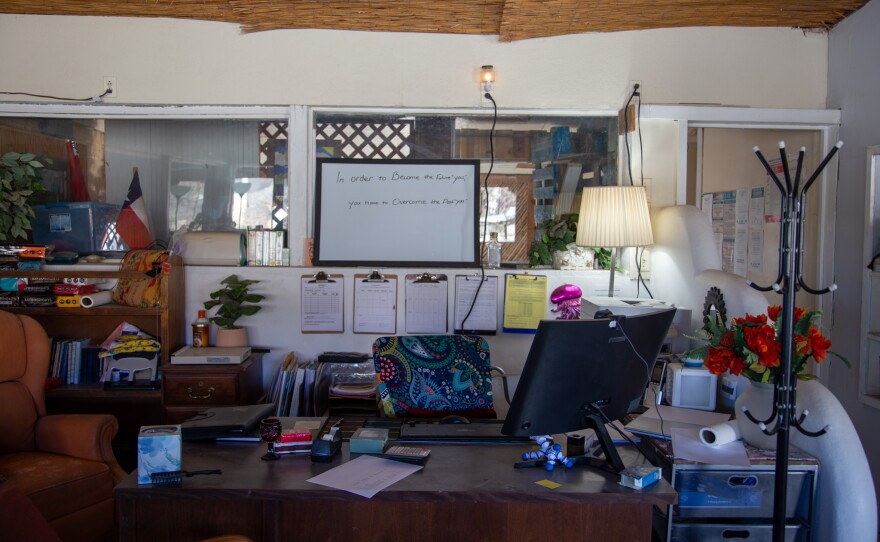

Mike Drinkard, a 20-year client advocate, can be found there most days.
Once a month, the office serves as the food distribution center for the entire area, with volunteers passing out hundreds of boxes of supplies.
“The days when we have the food there’s food everywhere and all the freezers are stuff full,” Drinkard said.
The Terlingua location is also known for its support groups and art classes. Drinkard said his work is emotionally sensitive, requiring him to be judgement-free.
“But it's a trauma-informed approach that we take, just knowing what the effects of trauma are and putting ourselves in their place,” he said.

The crisis center serves around 1,300 people a year, primarily women, according to the nonprofit. Last year, the group saw around 200 new clients. Client and legal advocate Virginia Sandoval said statistically speaking, that number should be higher, given the non-profit’s vast service area.
“We don’t have a huge population, but we are not immune to these types of assaults,” she said. “We know that, because we hear, people aren’t coming to us.”
Sandoval said fear, stigma and lack of faith in the legal system keep people away. That's why her group amplifies its reach by hosting education and awareness programs, where advocates talk to students about topics like healthy relationships and cyberbullying.
Sandoval said sometimes she watches students in the crowd, looking for visible reactions from those she thinks might be in an abusive relationship themselves.
“And their eyes kind of just like for a split second there's that ‘oh, wow,’” she said. “But then it quickly shuts down because they don't want anybody else to know that they made some kind of sign, that they’ve let on.”

Sandoval hasn’t had a single client press abuse or assault charges in the past year. The advocacy group Rape, Abuse & Incest National Network (RAINN,) citing FBI data, reports that for every 1,000 sexual assaults only 25 result in any jail time.
Kearns said even though her decision to open up to local advocates wasn’t easy, the consistent care they’ve shown her makes her feel like she’s a part of one big family.
“Especially over the years when the last thing you wanna do is cry out for help when you don’t know how to and then when you do and people actually come to you to help it's amazing,” she said.
While the crisis center’s services are free, the organization doesn’t receive a dollar from the majority of local governments it serves, except for Brewster County and the City of Alpine, which each contribute around $3,200 and $9,500 a year, respectively.
Carrillo, the executive director, said she’d like to see more investment from those entities moving forward, given the vital resources the center provides.
This reporting was made possible by generous donations from supporters like you. Please consider making a donation to Marfa Public Radio to fund the journalism you rely on.
